Wednesday, March 16, 2011

My Summer of Love

By Moira Sullivan 


Polish director Pawel Pawlikowski did post graduate studies in German literature before turning to film direction. In 2001 he received a BAFTA for being the most promising newcomer in British film and My Summer of Love won another special BAFTA in 2004 for best British film.
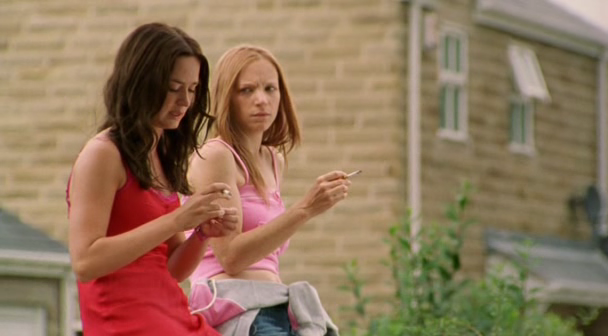
My Summer of Love stars Emily Blunt as Tamsin and Natalie Press as Mona, and is the story of two teenagers who meet during one summer.  The class difference is striking since Tamsin lives in a mansion and Mona lives in a pub called "The Swan" that her brother Phil (Paddy Considine) has converted into a prayer center.  Fresh out of prison he has found Jesus and decides to save himself, his community and his sister from temptation.
The emphasis of the film is on the relationship between Tamsin and Mona who have an adventurous summer exploring nature and human relationships including a special one that they embark on with each other. Mona hasn’t been very wise in picking mates before Tamsin and the two of them go to confront the wife of an older man who in the past had used her. They soon seem to compensate for the losses they have experienced at an early age: parenting, role models, and security and place their faith in each other.
Tamsin is a notorious liar and claims in one scene that Edith Piaf had three lovers who died mysteriously and one of them she stabbed with a fork, but nothing happened to her, she claims, because crimes of passion are forgiven in France. As Piaf’s "La Foule" spins on the record player, Tamsin with cigarette hanging out of her mouth dances with Mona around the room.  
Tamsin is actually quite seductive and predatory even if Mona has the real guts of the two and confronts her problems head on. But Tamsin is quite good in seeing through the hypocrisy of Mona’s brother and plays him as she obviously has done Mona.
Everything in Pawel Pawlikowski’s film is exceptional–the dialogue, costume, camera work and editing. The surprise ending of the film makes perfect sense and Pawlikowski’s background in literature serves him well.
It is clear that Emily Blunt was destined to be a major motion picture actress and her charisma shines through in this early film.  Natalie Press is also excellent although her career did not take off as much as Blunt’s. My Summer of Love is the kind of film that could have gone on much longer since every moment is precious and it well deserves the awards it received.
For Movie Magazine this is Moira Sullivan


© 2011 - Moira Sullivan - Air Date: 03/16/11
Movie Magazine International

Amours Imaginaires - Heartbeats

By Moira Sullivan
French Canadian Xavier Dolan’s narrative with a documentary edge, Heartbeats, begins with a quote by the 19th century French poet Alfred Musset:  there is a real world that reasons about love. (Il n’ya a de vrai au monde que d´raissoner d’amour). The original French title is Amours Imaginaires - Imaginary Lovers. The English title has no meaning for the premise of the film, as we shall see.

Heartbeats is an interesting film with an inventive and imaginative use of the camera. In the opening minutes, three young people speak about love while the camera changes focal lengths with abrupt close-ups and pull backs. It is not the last time this will happen.
The camera work in itself is worthy of investigation and the way Dolan frames his subjects. The film is made from a rich HD color film stock. It cost 7 million dollars to make and was selected for last years Cannes Film Festival fortnight section and last fall’s Mill Valley Film Festival. And it is now opening in San Francisco.
This is Dolan’s second feature. Three people—not the ones interviewed in the beginning, - Francis, Marie and Nicolas are played by Xavier Dolan, himself Monia Chokri, and Niels Schneider. They engage in what does not seem so much as a reasonable encounter with love but a very bizarre one wrought with tension and power struggles. We really never get to follow this chronologically. In one scene Francis discovers a rabbit in the forest only to be pounced on by Nicolas. Marie makes faces, and Francis makes screeching sounds when Nicolas is nearby. You kind of get to hate pretty Nicolas somehow.
The film doesn’t have so much of a story as a story like backdrop with a lot of posing, which includes many shots of Dolan’s Eraser head like hairdo from another decade.
There are pure cinematic moments to the film, which demand nothing of us  but  just laying back and watching the panorama of sound and image enfold. For example while a version of Sonny Bono’s song Bang Bang plays in the background sung by Dalida, Marie saunters down the street in a tight purple dress in slow motion. 


 The Swedish group The Knife also contributes to the soundtrack.
Other scenes include meeting at the opening of a play called "Migraine and "Sonatas", then back to interviews with several other young people speaking about love
The relationship between Francis and Nicolas is homoerotic but it is Marie who gets the first onscreen sex scene with another boy shot in red.
Xavier in green screen is shown with another man; the second sex scene is much tamer. Another scene in blue screen completes the sequences of physical love. The three sex scenes serve as artistic backdrops, which are unconnected to the so-called love triangle. After a rather long party scene the three imaginary lovers are shown sleeping in the same bed. How they got there, we don’t know-
As is customary in a French language treatment of love, the obligatory violoncello solo Suite no 1 by Bach hums in the background.  With a lot of smoking, drinking eating  - and coffee.
For Movie Magazine this is Moira Sullivan


© 2011 - Moira Sullivan - Air Date: 03/16/11
Movie Magazine International